
Real-world case study · Healthcare
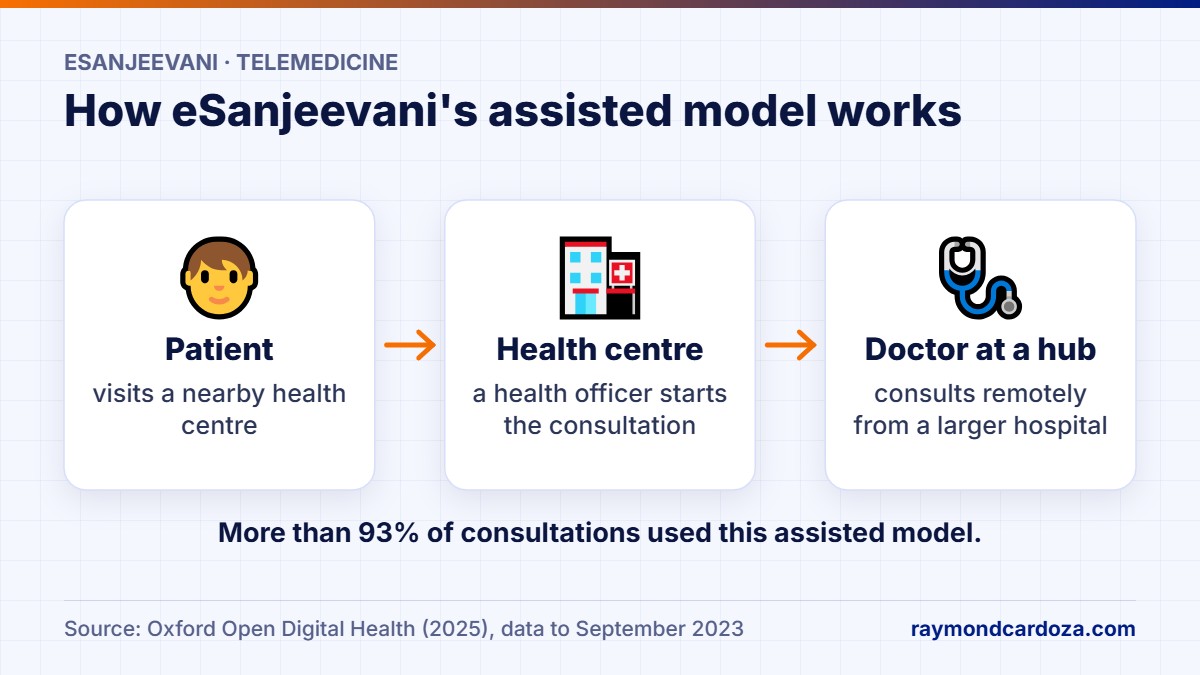
In short: eSanjeevani is the Government of India’s free national telemedicine service. Its main model is assisted: a health worker at a local centre connects the patient to a doctor at a hub hospital. A 2025 peer-reviewed study counted more than 163 million teleconsultations up to September 2023, over 93% through this assisted model, and the Ministry reported more than 432 million patients served by December 2025.
Most telemedicine products are built around a patient with a smartphone. eSanjeevani grew mainly through a different design, one that puts a trained health worker between the patient and the remote doctor. That choice explains much of its reach.
At a glance
- Organisation: Ministry of Health and Family Welfare, Government of India
- Industry: Public healthcare
- Country: India
- Period: Launched November 2019; data to December 2025
- Technology: National telemedicine platform with two models: assisted hub-and-spoke and direct-to-patient online OPD
- Developer: Centre for Development of Advanced Computing (C-DAC), Mohali
The challenge
Specialist and general doctors are concentrated in towns and cities, while many patients live far from them. Travelling for a consultation costs time and money, and many conditions that could be handled early are left until they become serious.
The situation before
The sources reviewed do not publish a detailed baseline. The design of the service points to the gap it was meant to close: frontline staff such as community health officers at primary facilities on one side, and doctors at larger hospitals on the other, with patients travelling between them whenever a doctor’s opinion was needed.
The solution
The platform runs two models, described in the Oxford Open Digital Health study:
- eSanjeevani AB-HWC (assisted, hub-and-spoke): a community health officer at a primary facility (the spoke) connects the patient to a doctor at a secondary or tertiary hospital (the hub).
- eSanjeevani OPD (direct-to-patient): rolled out on 13 April 2020, during the first COVID-19 lockdown, so that people with internet access could consult government doctors remotely.
Implementation
The study reports that the number of hubs grew from 397 in 2020 to 14,036 by September 2023. By December 2025 the Ministry reported 136,571 health facilities working as spokes, supported by 18,176 hubs and 781 online OPDs, with more than 2.31 lakh healthcare providers on the platform.
The assisted model carried most of the load. According to the study it accounted for more than 93% of usage.
Documented results
- More than 163 million teleconsultations up to September 2023, across all 28 states and 8 union territories (Oxford Open Digital Health, 2025)
- More than 432 million patients served free of cost as of 17 December 2025 (Ministry of Health and Family Welfare year-end review)
- Women made up 57.7% of assisted consultations and 70.1% of OPD consultations by 2023 in the study; the Ministry reports 57% women and 14% senior citizens among beneficiaries
- Five states generated about 71% of consultations in the study period
- Average consultation length was about 1 minute 15 seconds
The two headline figures use different measures (teleconsultations in the study, patients in the Ministry review) and different dates, so they should not be compared directly. The study also notes that patient outcomes, continuity of care and equity of access could not be fully assessed from the available data.
Why this matters
The assisted model is the lesson. Rather than requiring every patient to own a device, download an app and know how to use it, eSanjeevani placed the technology with trained staff at a location people already visit. Adoption followed the people, not the app.
The uneven spread across states is also instructive. A platform can be available everywhere and still be used heavily in only some places. Local leadership, staffing and process matter as much as the software.
What businesses can learn
- Design for the real user journey. If customers struggle with self-service, an assisted model may reach more of them.
- Use hubs for scarce expertise. Centralise specialists and connect them to many front-line points.
- Measure more than volume. Counts of consultations or logins do not show outcomes or quality.
- Expect uneven adoption. Plan for regional differences in training and support.
Raymond Cardoza Enterprises perspective
Healthcare businesses such as clinics, diagnostic centres and pharmacies can apply the same thinking at a smaller scale: decide which steps a patient should do alone and which should be assisted by staff, then build the records, reminders and hand-offs around that. Our business automation and business solutions teams start every healthcare project with that journey map, as in our appointment reminder case study.
Sources and verification
Every figure in this case study comes from the sources below. Primary sources are listed first.
- Ministry of Health and Family Welfare, Initiatives and Achievements 2025 (PIB, published January 2026)
- Sood, Verma et al. (2025), Adoption and utilization of India’s eSanjeevani national telemedicine service, Oxford Open Digital Health
- PIB (Sept 2021): eSanjeevani completes 1.2 crore consultations (development by C-DAC Mohali, launch dates)
Planning a digital service for patients or customers?
We can help you decide what should be self-service, what should be assisted, and what systems sit behind both.
Call +91 98804 69174 · info@raymondcardoza.com · Business Automation services
Case study type: External real-world case study - not a Raymond Cardoza Enterprises client project. eSanjeevani (Ministry of Health and Family Welfare, Government of India) is not a client of Raymond Cardoza Enterprises, and RCE had no involvement in the project described. This analysis is based only on the public sources listed above, as available in October 2026.