
Real-world case study · Education Technology
In short: DIKSHA is India’s national digital platform for school education, launched on 5 September 2017 and built on the open-source Sunbird software. Its best-known feature is the QR-coded “energised” textbook: scan a code in a printed book and open matching videos and teacher guides. By June 2026 the government reported 575.25 crore learning sessions and 2.25 crore registered users, alongside about 3 lakh daily active users.
Many EdTech products ask schools to replace what they already use. DIKSHA took a different route. It started from the printed textbook every student already has and linked it to digital content. That design decision is the most transferable lesson in this case.
At a glance
- Organisation: Ministry of Education, with NCERT and CIET
- Industry: School education
- Country: India
- Period: Launched 5 September 2017; data to 27 June 2026
- Technology: Open-source Sunbird platform, federated content model, QR-coded textbooks
- Scope: Adopted by almost all states, union territories and central bodies including CBSE (UNESCO)
The challenge
India’s school system is very large and multilingual, with each state running its own curriculum and textbooks. A single national app with a single set of content would not fit. At the same time, teachers and students needed quality digital material linked to what was actually being taught.
The situation before
The sources reviewed do not give a detailed baseline. Content was produced by many separate bodies, and printed textbooks had no direct link to digital resources.
The solution
- Open-source foundation: UNESCO’s financing toolkit notes that DIKSHA is built on Sunbird, open-source technology designed to be scalable and adaptable.
- Federated content: the PIB factsheet describes a federated architecture in which each participant uploads and manages its own content, with periodic validation by CIET-NCERT.
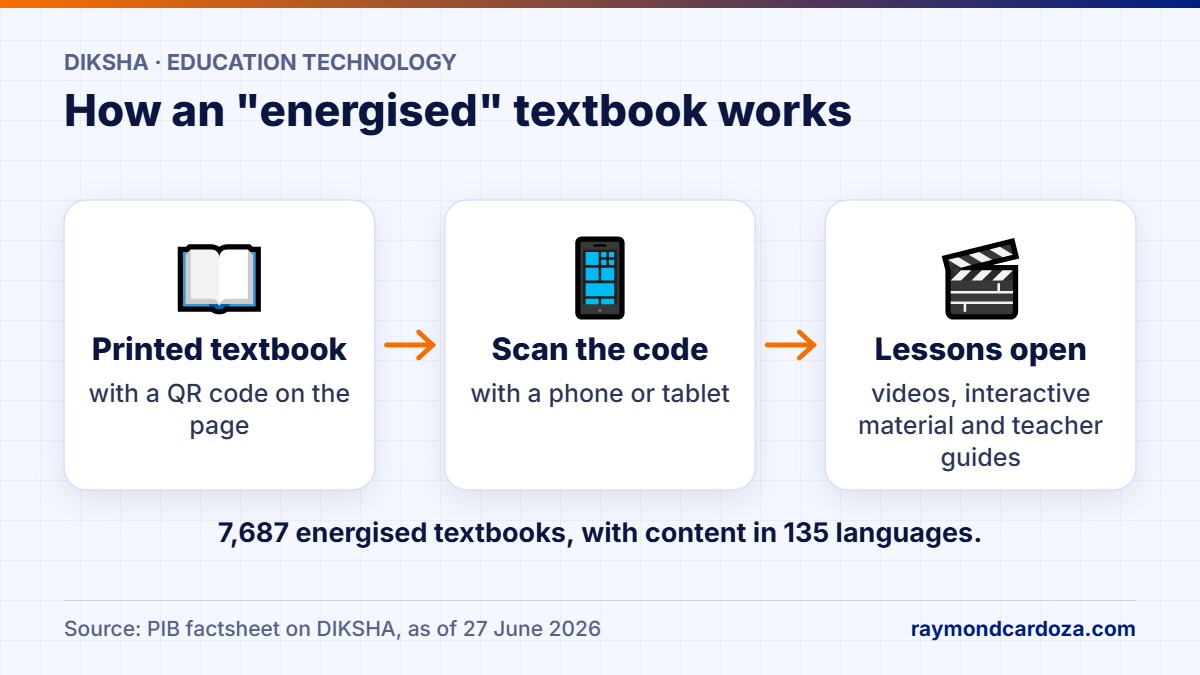
- Energised textbooks: QR codes printed in textbooks link physical NCERT books to videos, interactive material and teacher guides.
- One platform for school education: under PM eVIDYA, DIKSHA is positioned as “One Nation, One Digital Platform”.
Implementation
NCERT leads the platform with CIET. UNESCO describes three funding routes: government grants, public-private partnerships (including Bharti Airtel for cloud services and Oracle Cloud for infrastructure) and corporate social responsibility funding. States and central bodies contribute and manage their own content on the shared platform.
Documented results
Figures from the PIB factsheet, as of 27 June 2026:
- 575.25 crore learning sessions and 6,691.82 crore learning minutes
- 2.25 crore registered users and about 3 lakh daily active users
- 7,687 energised textbooks, 3.67 lakh e-contents and 614 virtual laboratories
- Content in 135 languages (128 Indian and 7 foreign)
UNESCO separately reports 19,698 courses with 182.3 million enrolments and 145.7 million completions, without a stated date, and mentions support for 36 languages. The language counts differ between the two sources, likely because of different dates or definitions.
Sessions and minutes measure activity, not learning outcomes. The gap between registered users and daily active users also suggests that regular use is concentrated in a smaller group. UNESCO lists device and connectivity requirements, uneven language coverage, infrastructure dependence and reliance on private partners as challenges.
Why this matters
Linking a familiar physical object to digital content lowered the barrier to adoption. Teachers did not need to change textbooks or learn a new curriculum. The open-source, federated model let many content owners share one platform while keeping control of their own material.
The usage data also shows a common EdTech pattern: reaching registrations at scale is easier than building daily habits.
What businesses can learn
- Start from what users already have. A QR code on a page is easier than a new device or app.
- Let content owners manage their own content. A federated model scales better than one central team.
- Choose open standards where you can. They reduce lock-in and let partners build on the same base.
- Track active use, not just sign-ups. Daily and weekly engagement tells you whether the tool is part of routine.
Raymond Cardoza Enterprises perspective
Schools and colleges adopting digital tools get better results when technology fits existing classroom routines. Whether the project is a learning portal, a school management system or a library platform, we begin by mapping how teachers and students already work. Our education projects division covers this planning and setup.
Sources and verification
Every figure in this case study comes from the sources below. Primary sources are listed first.
- PIB factsheet (June 2026): DIKSHA – Powering India’s Digital Learning Ecosystem
- PIB document (28 June 2026): DIKSHA – Powering India’s Digital Learning Ecosystem (PDF)
- UNESCO, Financing the digital transformation of education: DIKSHA
Bringing digital learning to your school or college?
Tell us how your classrooms run today. We will help you choose tools that fit your teachers’ routine instead of replacing it.
Call +91 98804 69174 · info@raymondcardoza.com · Education Projects services
Case study type: External real-world case study - not a Raymond Cardoza Enterprises client project. DIKSHA (Ministry of Education, Government of India) is not a client of Raymond Cardoza Enterprises, and RCE had no involvement in the project described. This analysis is based only on the public sources listed above, as available in October 2026.