
Real-world case study · AI Customer Service
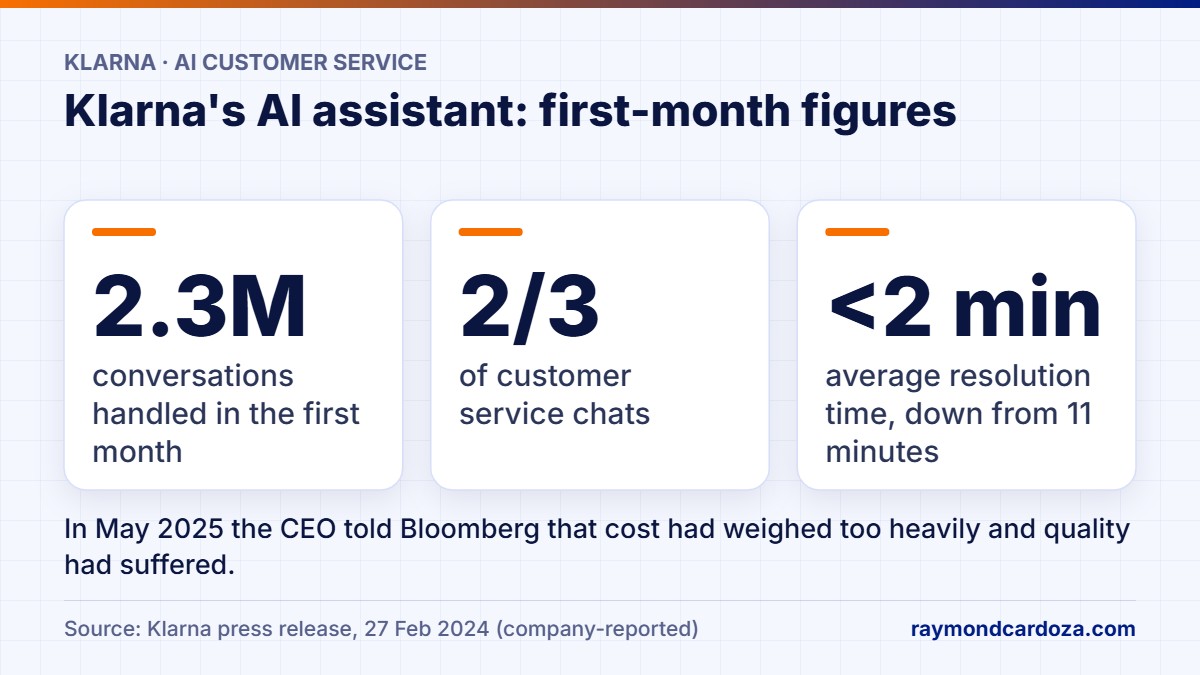
In short: In February 2024 Klarna said its OpenAI-powered assistant had handled 2.3 million conversations in its first month, two-thirds of its customer service chats, with average resolution time falling from 11 minutes to under 2. In May 2025 its CEO told Bloomberg that cost had been “a too predominant evaluation factor” and that the result was lower quality, and Klarna began piloting human agents again.
Klarna’s announcement became one of the most quoted examples of AI in customer service. What happened next is just as useful. Taken together, the two halves of the story show what AI support can do and what it needs around it.
At a glance
- Company: Klarna
- Industry: Payments and consumer finance (buy now, pay later)
- Country: Sweden, operating internationally
- Period: Launch reported February 2024; follow-up statements May 2025
- Technology: AI assistant built with OpenAI
- Scope reported: 23 markets, more than 35 languages, available 24/7
The challenge
Klarna serves a very large consumer base across many countries. Its press release put the figure at 150 million consumers. Customer questions about refunds, returns, payments, cancellations, disputes and invoice errors arrive around the clock and in many languages, which makes support expensive to staff and slow to scale.
The situation before
Before the assistant, these chats were handled by human agents. Klarna’s release gives one useful baseline: the average time to resolve an errand was 11 minutes. Public sources do not give a detailed breakdown of team size or cost before the change.
The solution
Klarna launched an AI assistant, built with OpenAI, inside its app. According to the company it handles refunds, returns, payment-related questions, cancellations, disputes and invoice inaccuracies, and it works in more than 35 languages across 23 markets.
Implementation
The assistant was rolled out globally and Klarna published results after one month of live operation. The public sources do not describe the internal build, testing process or escalation design in detail, so this case study does not speculate about them.
Documented results
Klarna reported the following for the first month:
- 2.3 million conversations, two-thirds of its customer service chats
- Work equivalent to 700 full-time agents
- Customer satisfaction on par with human agents
- 25% fewer repeat inquiries
- Average resolution time under 2 minutes, down from 11 minutes
- An estimated USD 40 million profit improvement for 2024 (a company projection, not a reported result)
These figures are Klarna’s own and were not independently audited in the sources reviewed.
In May 2025, CEO Sebastian Siemiatkowski told Bloomberg: “As cost unfortunately seems to have been a too predominant evaluation factor when organising this, what you end up having is lower quality.” Silicon Republic, reporting on that interview, said Klarna had started a pilot to recruit remote freelance agents while stating it remained AI-first.
Why this matters
The first-month numbers show that a well-built assistant can take on a large share of routine questions quickly and in many languages. The follow-up shows that the measure of success matters. If an AI project is judged mainly on cost saved, quality problems can build up until customers feel them.
For most businesses the practical target is not “replace the team”. It is “answer routine questions instantly, and make it easy to reach a capable person for the rest”.
What businesses can learn
- Measure quality as closely as cost. Track resolution rate, repeat contacts and satisfaction, not just volume handled.
- Start with routine, well-documented questions. Refund status and payment dates suit automation better than disputes.
- Design the hand-off. Customers should reach a person without repeating themselves.
- Treat vendor and company figures as claims. Run your own pilot and compare against your own baseline.
- Plan to adjust. Klarna changed course publicly within about a year. Build review points into any AI rollout.
Raymond Cardoza Enterprises perspective
An AI assistant is only as good as the knowledge, workflows and escalation rules behind it. Businesses considering one should first list their most common questions, connect the assistant to accurate data and decide exactly when a human takes over. That is the approach behind our business automation work, and it pairs naturally with the follow-up systems described in our lead capture and follow-up case study.
Sources and verification
Every figure in this case study comes from the sources below. Primary sources are listed first.
- Klarna press release via PR Newswire (27 Feb 2024): Klarna AI assistant handles two-thirds of customer service chats in its first month
- OpenAI customer story: Klarna’s AI assistant does the work of 700 full-time agents
- Silicon Republic (May 2025), reporting Bloomberg interview: Did Klarna’s AI reliance affect customer service quality?
Thinking about AI for customer support?
Tell us which questions your team answers most. We will show you what can be automated safely and where a person should stay in the loop.
Call +91 98804 69174 · info@raymondcardoza.com · Business Automation services
Case study type: External real-world case study - not a Raymond Cardoza Enterprises client project. Klarna is not a client of Raymond Cardoza Enterprises, and RCE had no involvement in the project described. This analysis is based only on the public sources listed above, as available in October 2026.