
In short: Growing SMEs often outgrow registers, spreadsheets and WhatsApp long before they notice. The fix is not a big software purchase but a staged move: map the real workflows, pick the few systems that matter, migrate clean data, train the team and switch over one process at a time. That staged move is what SME digital transformation looks like in practice.
Most small businesses in India start with a notebook, a spreadsheet and a phone. That works for the first few years. Then customers, staff and branches grow, and the same tools start costing time, money and sleep. This SME digital transformation case study describes the challenges we typically see and how we set up the move to one connected system.
The challenge: the business outgrew its tools
- Information in too many places: orders on WhatsApp, customer details in a notebook, invoices in a separate billing tool.
- Everything depends on one person: the owner or one senior staff member is the only one who knows where things are.
- Rework and errors: the same data typed two or three times, with mistakes at every step.
- No live numbers: sales, dues and stock are only known at month end, if at all.
- Hard to delegate or scale: new staff take months to learn how things “really” work.
How we set up an SME digital transformation
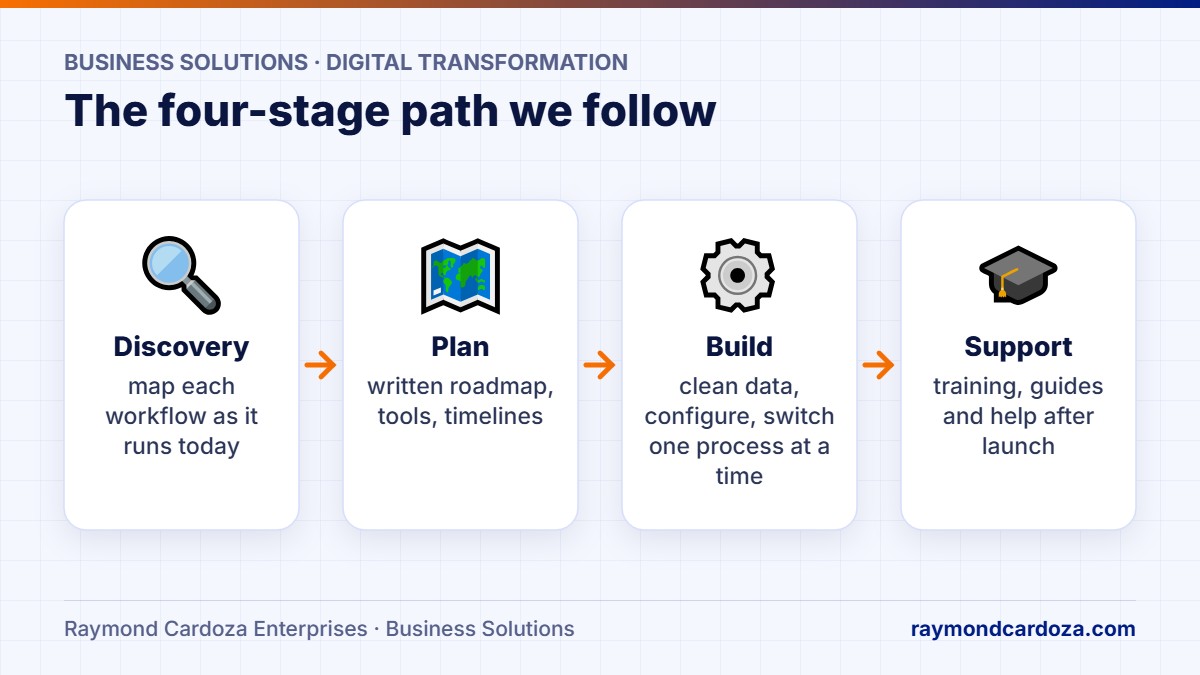
We follow the same four-stage path on every engagement: discovery, plan, build, support.
- Discovery: we sit with the team and map each workflow as it actually runs today, including the workarounds.
- A clear plan: a written roadmap covering which processes move first, which tools are used (CRM, billing or ERP, document management), timelines and transparent pricing.
- Clean data first: customer, product and supplier lists are cleaned and deduplicated before migration.
- Configure and connect: systems are set up around your process, and connected so data is entered once.
- Staged switch-over: one process at a time, with the old method kept as a fallback until the team is confident.
- Training and support: short role-based training, simple written guides, and post-launch support while the new habits settle.
What changes after go-live
- One place to find a customer, an order or an invoice.
- Less retyping and fewer errors between departments.
- Owners see sales, dues and pending work without asking anyone.
- New staff learn a documented process instead of tribal knowledge.
- A foundation for automation and growth, rather than more manual workarounds.
Is your business ready?
If you recognise three or more of the challenges above, a staged SME digital transformation is usually worth it. See our Business Solutions page, or, if the pain is repetitive manual work, our Business Automation services.
Frequently asked questions
Do we have to replace all our software at once?
No. We usually keep what works, replace what does not, and switch over one process at a time.
How long does a digital transformation take?
It depends on the number of processes and people involved. The written plan gives you timelines for each stage before work begins.
Will our team be able to use it?
Training is part of the engagement, and we stay on after launch while the team settles in.
Talk to us about your business
Tell us where things are stuck. We will listen, define the scope and send a clear plan with timelines and transparent pricing.
Call +91 98804 69174 · info@raymondcardoza.com · Business Solutions services
This case study describes a typical engagement based on situations clients bring to us. Scope, timelines and pricing are agreed separately for every project.