
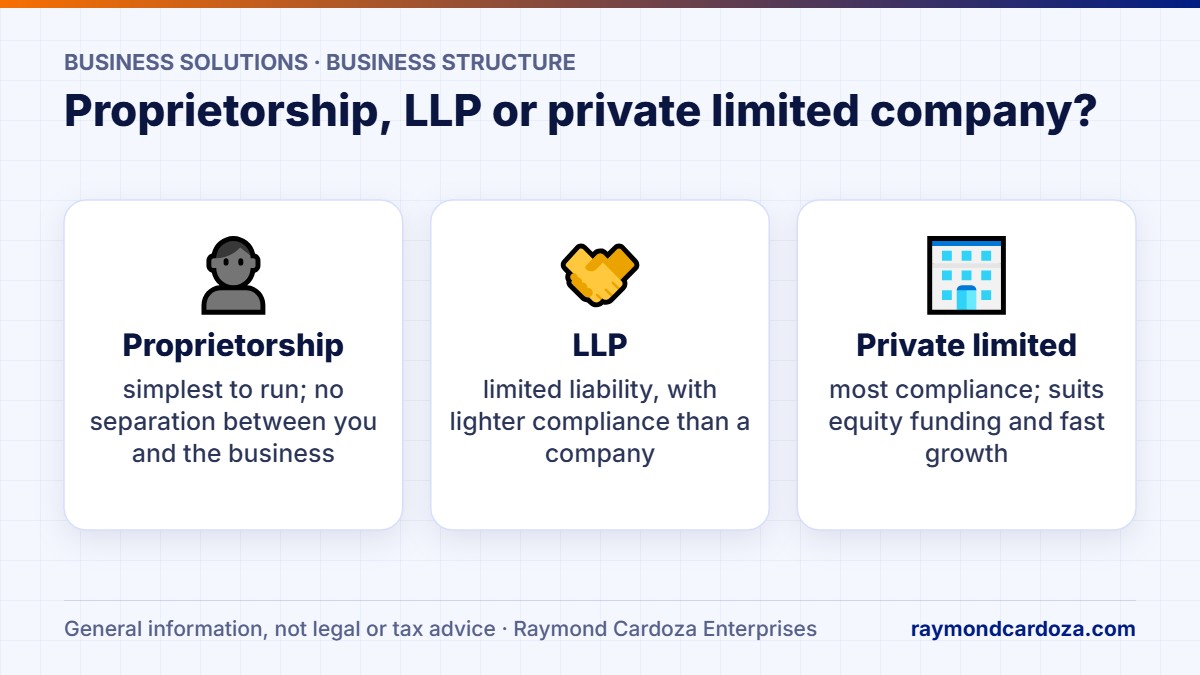
Quick answer: A proprietorship is the simplest and cheapest to run but gives no separation between you and the business. An LLP adds limited liability with lighter compliance than a company. A private limited company has the most compliance but suits businesses planning to raise equity funding or scale fast. The right choice depends on risk, partners and growth plans. This guide compares proprietorship vs LLP vs private limited in plain language.
Choosing a business structure is one of the first decisions a founder makes, and one of the hardest to undo later. Here is a comparison of proprietorship vs LLP vs private limited company structures in India and the questions that usually decide the answer.
Proprietorship vs LLP vs private limited at a glance
- Sole proprietorship: quick to start and easy to run. The owner and the business are legally the same, so personal assets are exposed to business liabilities.
- Partnership firm: two or more partners under a partnership deed. Simple, but partners generally carry unlimited liability.
- Limited Liability Partnership (LLP): a separate legal entity with limited liability for partners and a flexible internal structure. Annual filings are required.
- Private limited company: a separate legal entity with shareholders and directors. Higher compliance, but the preferred structure for equity investors.
Questions that decide the right structure
- How much risk does the business carry? Contracts, loans and liabilities push towards limited liability.
- Are there partners? Multiple owners usually need an LLP or a company with clear agreements.
- Will you raise investment? Equity investors usually expect a private limited company.
- How much compliance can you handle? Each step up adds filings, audits and costs.
- Where is the business going in three to five years? Choose for the next stage, not only for today.
Registrations that often come next
- MSME/Udyam registration for eligible micro, small and medium enterprises.
- GST registration when turnover crosses the threshold or the business type requires it.
- Other statutory registrations such as shop and establishment, professional tax or industry-specific licences.
How we help
Our Business Solutions team supports registration for proprietorships, partnerships, LLPs, private limited companies and MSME/Udyam, along with GST filing and annual compliance. If you are still weighing proprietorship vs LLP vs private limited, we start by understanding your plans, then handle the paperwork. See Business Solutions for details.
Frequently asked questions
Can I convert a proprietorship to an LLP or company later?
Yes, conversion is possible, but it involves paperwork and costs. Choosing well at the start saves effort later.
Which structure has the least compliance?
A sole proprietorship generally has the lightest compliance, followed by partnership and LLP. A private limited company has the most.
Is this legal or tax advice?
No. It is general guidance. Rules and thresholds change, so confirm your specific situation with a qualified professional.
Talk to us about your business
Tell us where things are stuck. We will listen, define the scope and send a clear plan with timelines and transparent pricing.
Call +91 98804 69174 · info@raymondcardoza.com · Business Solutions services
This article is general information and not legal or tax advice. Thresholds and procedures change, so please confirm your situation with a qualified professional.