
Real-world case study · Automation & Integration
In short: X-Road is the secure data exchange layer behind Estonia’s digital services. National deployment began on 17 December 2001 to connect government databases that had been working in isolation. Each organisation keeps its own data; X-Road signs, encrypts and logs the exchanges between them. e-Estonia reports 2.2 billion transactions a year, more than 3,000 e-services and use in over 20 countries.
Most businesses have the same problem Estonia set out to solve: information sits in separate systems, so people re-enter it, email it or ask customers for it again. X-Road shows a way to fix that without merging everything into one giant database.
At a glance
- Organisation: Republic of Estonia; now developed with Finland through the Nordic Institute for Interoperability Solutions (NIIS)
- Industry: Government and public services, with private-sector participants
- Country: Estonia (also used in more than 20 other countries, per e-Estonia)
- Period: National deployment from 17 December 2001
- Technology: X-Road secure data exchange layer
- Principle: “Once only”: the same information should not be asked for twice
The challenge
According to the X-Road history published by its developers, Estonian public administration databases “were in isolation and data exchange between agencies, ministries and organizations was slow and inefficient.”
The situation before
The sources reviewed do not quantify the delays. They describe separate agency databases with no common, secure way to exchange data, which in practice means information is requested again or passed between offices by hand.
The solution
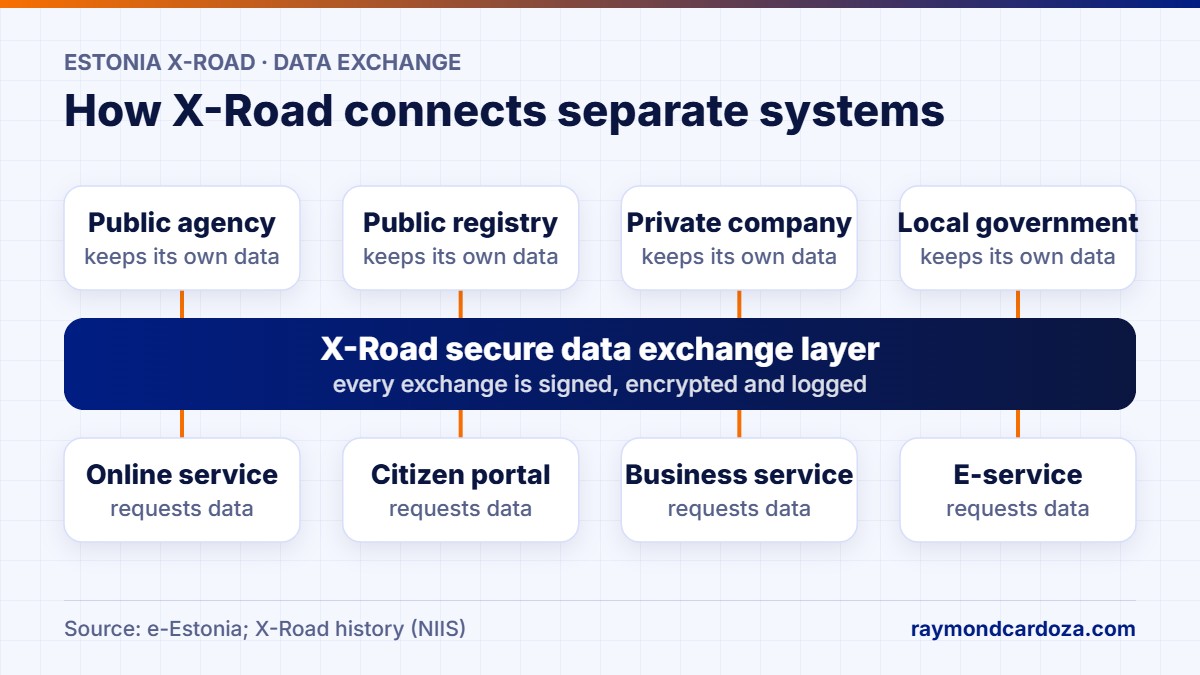
X-Road is not a central database. e-Estonia describes it as “a secure data exchange layer for sending and receiving data between both private and public sector organisations.” Each organisation keeps its own system and data, and X-Road handles the exchange:
- Outgoing data is digitally signed and encrypted
- Incoming data is authenticated and logged
- Organisations connect once and can then exchange data with others on the network
The technology supports a policy rule. A Harvard Kennedy School policy brief explains Estonia’s “once-only” principle, that the same information should not be asked for twice, and notes that the 2007 Public Information Act prohibits departments from setting up separate databases to collect identical data.
Implementation
- 2001: version 1.0 and national deployment from 17 December
- 2002 to 2014: versions 2.0 to 6.0, adding asynchronous services, security updates and improved data integrity
- March 2017: Estonia and Finland agree to jointly develop X-Road through NIIS
- February 2018: data exchange federation between Estonia and Finland
- 2021: version 7.0 released; 2024: version 8.0 proof of concept announced
Documented results
- 2.2 billion transactions per year (e-Estonia)
- More than 3,000 e-services and 52,000 organisations as indirect users (e-Estonia)
- Implemented in over 20 countries (e-Estonia)
Reported time savings vary by source and year. Cybernetica, an Estonian technology company, reported 1,407 years of working time saved in one year, up from 804 years in 2017. The Harvard Kennedy School brief cites 844 years saved annually. The sources reviewed do not explain the calculation method, so these figures should be read as estimates rather than measured results.
Why this matters
The design choice is the lesson. Estonia did not try to put all data in one place. It left each system with its owner and built a secure, logged way for systems to talk to each other. That reduced duplicate data entry while keeping clear responsibility for each record.
Inside a business, the same idea means your CRM, billing, inventory and HR tools share data through integrations rather than staff copying it between screens.
What businesses can learn
- Adopt a once-only rule. Decide that customer and staff data is entered once and reused everywhere.
- Integrate rather than centralise. Connect the tools you have through APIs and automation before replacing them.
- Log every exchange. Knowing who accessed or sent which data builds trust and supports compliance.
- Name an owner for each dataset. One system is the source of truth for each type of record.
- Treat integration as ongoing. X-Road has gone through eight major versions over two decades.
Raymond Cardoza Enterprises perspective
For a growing business, the equivalent of X-Road is a set of reliable integrations between the tools it already uses, so a customer’s details, an order or an invoice are entered once and flow where they are needed. We design those integrations and automations through our business automation practice, building on the approach in our SME digital transformation case study.
Sources and verification
Every figure in this case study comes from the sources below. Primary sources are listed first.
- X-Road (NIIS): X-Road history
- e-Estonia: X-Road
- Harvard Kennedy School, Ash Center policy brief: Deploying the Once-Only Policy (PDF)
- Cybernetica: Saving 1407 years of working time in Estonia
Is your team re-typing the same data into different systems?
Show us your tools and where data gets copied by hand. We will map the integrations that would remove it.
Call +91 98804 69174 · info@raymondcardoza.com · Business Automation services
Case study type: External real-world case study - not a Raymond Cardoza Enterprises client project. Estonia’s X-Road (Republic of Estonia) is not a client of Raymond Cardoza Enterprises, and RCE had no involvement in the project described. This analysis is based only on the public sources listed above, as available in October 2026.