
Real-world case study · E-commerce
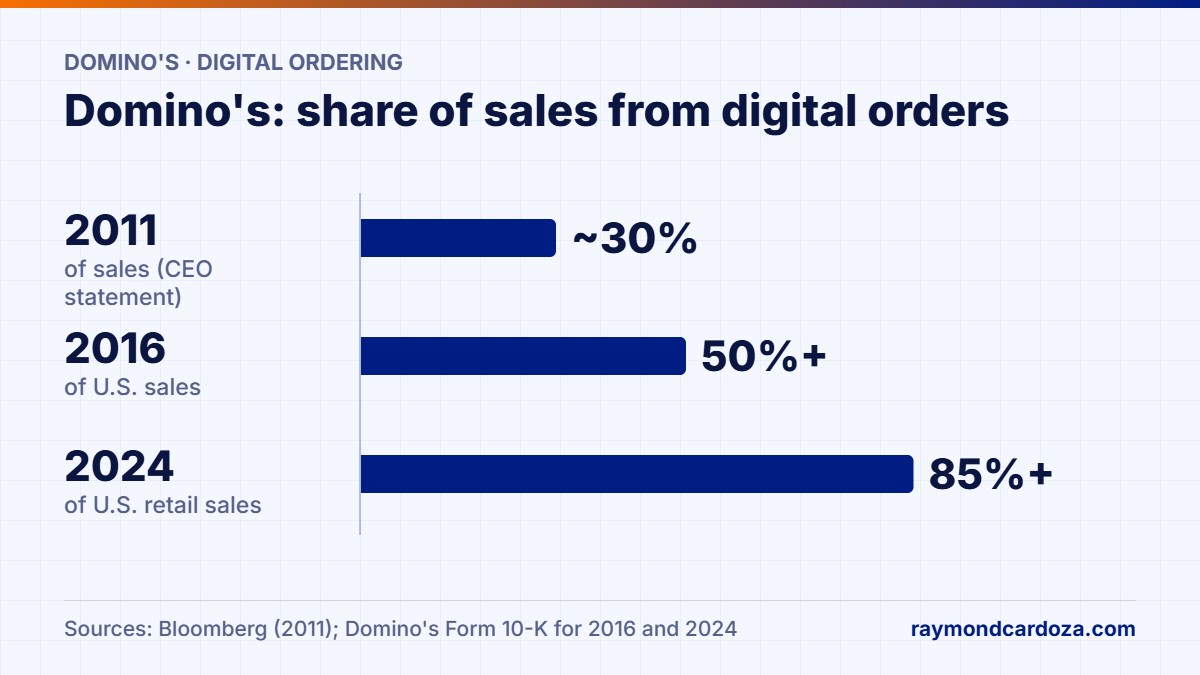
In short: Domino’s said in 2011 that digital orders were approaching 30% of its sales. Its annual report for 2016 said more than half of U.S. sales came through digital platforms, and its 2024 annual report says more than 85% of U.S. retail sales came from digital channels. The common thread across those filings is that Domino’s built and owns the key systems: ordering apps, the PULSE point-of-sale system, the DOM OS store operating system and its loyalty program.
Domino’s is often described as a technology company that sells pizza. The company’s own filings show what that means in practice: a steady, multi-year investment in systems that it controls, from the order button to the store kitchen.
At a glance
- Company: Domino’s Pizza, Inc.
- Industry: Quick-service restaurants, delivery and carryout
- Country: United States, with international franchise markets
- Period: 2011 to 2024
- Technology: Own web and mobile ordering platforms, Domino’s PULSE point-of-sale, DOM OS, Domino’s Rewards
- Scale: 21,366 stores at the end of fiscal 2024 (7,014 U.S., 14,352 international)
The challenge
Pizza delivery depends on taking orders quickly and accurately, passing them to the kitchen and getting them out the door. Phone orders are slow to take, easy to get wrong and hard to analyse. As customers moved to phones and apps, the question for any delivery business was who would own the ordering relationship.
The situation before
In October 2011 Bloomberg reported CEO J. Patrick Doyle saying that digital orders, through the website and smartphone apps, were approaching 30% of sales. The majority of orders still came through other channels, including the phone.
The solution
Domino’s filings describe a set of systems the company built and runs itself:
- Digital ordering everywhere: by 2016 the company reported mobile apps covering 95% of U.S. smartphones and tablets, plus ordering through voice assistants, smartwatches, smart TVs, social media and text.
- Domino’s PULSE: a proprietary point-of-sale system, which the 2016 annual report said was in every U.S. company-owned store and more than 99% of U.S. franchised stores.
- DOM OS: described in the 2024 annual report as the combination of tools, processes and technologies that orchestrate store operations, including the flow of orders.
- Loyalty: Piece of the Pie Rewards launched in 2015; the program was relaunched as Domino’s Rewards in 2023.
Implementation
This was a gradual build rather than one project. The filings show new ordering channels added year by year, a single point-of-sale system pushed out across the franchise system, and continuing investment. In its 2024 annual report Domino’s said it had completed a redesign of its e-commerce platforms and planned to roll them out across the U.S. system in 2025.
Documented results
- About 30% of sales from digital orders in 2011 (Bloomberg, quoting the CEO)
- More than half of U.S. sales via digital platforms in 2016 (Form 10-K for fiscal 2016)
- More than 85% of U.S. retail sales from digital channels in 2024 (Form 10-K for fiscal 2024)
- Fiscal 2024 global retail sales growth of 5.9% excluding currency effects, and U.S. same store sales growth of 3.2% (Q4 and fiscal 2024 results release)
Public sources do not isolate how much of Domino’s sales growth is caused by its technology rather than other factors such as pricing, store growth or marketing.
Why this matters
When customers order through your own website or app, you keep the customer data, the relationship and the margin. Domino’s connected that front end to its own store system, so a digital order flows straight to the kitchen without re-entry.
For smaller businesses, the lesson is not to build everything in-house. It is to make sure your main ordering channel, your stock and your customer records are connected and under your control.
What businesses can learn
- Own your primary ordering channel. Marketplaces bring reach, but your own channel keeps the customer relationship.
- Connect the front end to operations. Orders should reach billing, stock and fulfilment without being typed again.
- Standardise the store system. One system across locations gives comparable data.
- Invest steadily. Domino’s progress came over more than a decade, not from one launch.
- Use loyalty data. Rewards programs show who orders, how often and what brings them back.
Raymond Cardoza Enterprises perspective
A restaurant, retailer or distributor does not need Domino’s budget to apply the same principle: one connected path from order to fulfilment, with customer data you own. Our e-commerce and trading team builds that path, and our multichannel inventory case study shows how stock stays in sync across your own store and marketplaces.
Sources and verification
Every figure in this case study comes from the sources below. Primary sources are listed first.
- Domino’s Pizza, Inc. Form 10-K for fiscal 2024 (SEC)
- Domino’s Pizza, Inc. Form 10-K for fiscal 2016 (Domino’s investor relations)
- Domino’s Q4 and fiscal 2024 financial results release
- Bloomberg (18 Oct 2011): Domino’s Pizza says digital orders approaching 30% of all sales
Want more orders through your own channel?
We will look at how orders reach you today and show you what a connected ordering and fulfilment setup would look like.
Call +91 98804 69174 · info@raymondcardoza.com · e-Commerce & Trading services
Case study type: External real-world case study - not a Raymond Cardoza Enterprises client project. Domino’s Pizza is not a client of Raymond Cardoza Enterprises, and RCE had no involvement in the project described. This analysis is based only on the public sources listed above, as available in October 2026.