
Real-world case study · Data & Analytics
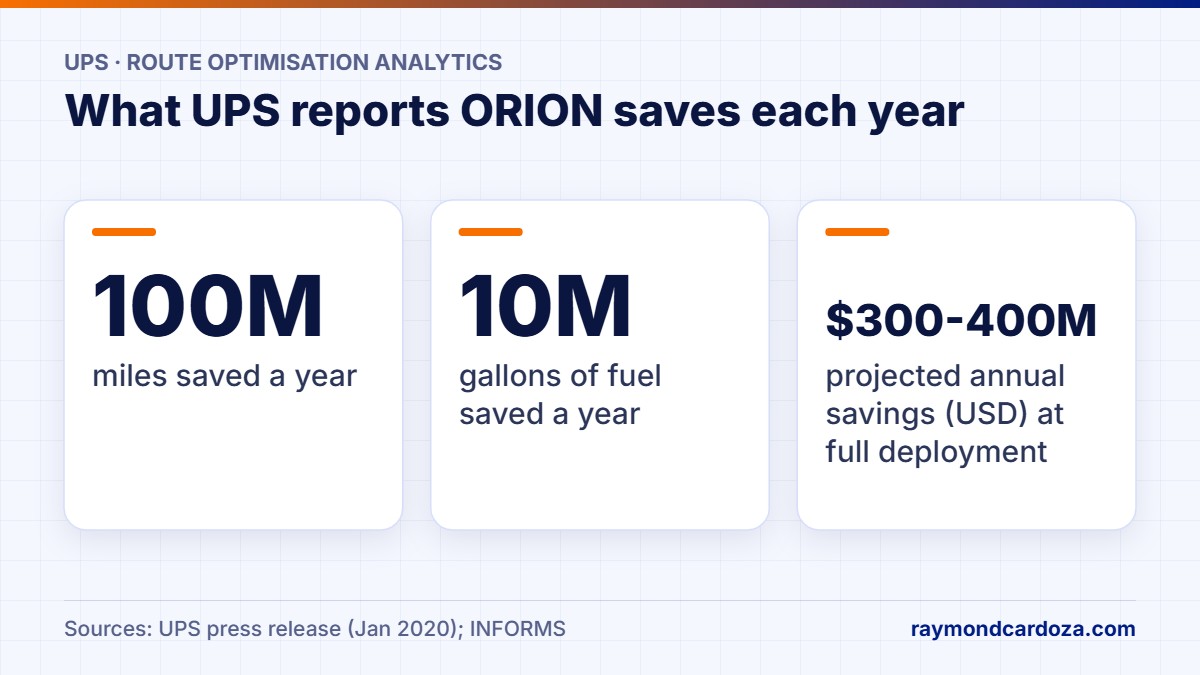
In short: UPS developed ORION (On-Road Integrated Optimization and Navigation) to calculate the best sequence of stops for each driver every day. INFORMS reports a project cost of about USD 250 million against projected savings of USD 300-400 million a year. UPS says that since deployment began in 2012, ORION has saved about 100 million miles and 10 million gallons of fuel per year. The biggest obstacle was not the maths but persuading experienced drivers to trust it.
Route optimisation sounds like a pure software problem. UPS’s experience shows that the algorithm was only half the work. The other half was changing how drivers and managers measured a good day on the road.
At a glance
- Company: United Parcel Service (UPS)
- Industry: Parcel delivery and logistics
- Country: United States, later Canada and Europe
- Period: Development from 2003 (BSR); deployment from 2012; dynamic version announced January 2020
- Technology: ORION route optimisation built on UPS Package Flow Technology data
- Recognition: 2016 INFORMS Franz Edelman Award
The challenge
Each UPS driver makes many stops a day. INFORMS puts the average at about 160 customers per driver. The order in which those stops are made has a large effect on miles driven and fuel used. BSR notes that UPS estimated a reduction of just one mile per driver per day was worth about USD 50 million a year.
The situation before
Before ORION, the order of stops relied heavily on drivers’ own experience of their routes. According to BSR, “Many people didn’t believe that a computer-generated algorithm could be an improvement over decades of driver experience.” Drivers were also measured against their own past performance on a route, not against an ideal route.
The solution
ORION gives each driver an optimised delivery sequence for the packages assigned to them each morning. According to INFORMS it was built on UPS’s earlier Package Flow Technology and combines data from multiple sources, public as well as proprietary, with advanced analytical tools. In January 2020 UPS announced a dynamic version that updates directions while drivers are on the road, based on changing conditions and commitments.
Implementation
- More than ten years of development, with about three years of intensive field testing (INFORMS)
- Rollout across U.S. routes from 2012; by December 2015, 35,000 of about 55,000 U.S. drivers were using ORION (INFORMS)
- “ORION rides” in rental cars to show managers and drivers why the routes, sometimes counterintuitive, worked (BSR)
- A system designed to be easily understood by drivers, with training to match (BSR)
- New performance measures that compared each route against an optimised ideal rather than its own history (BSR)
Sources differ on the completion date: INFORMS gives 2016 for full U.S. deployment and BSR gives a 2017 target. By 2020 UPS said ORION covered more than 66,000 routes in the U.S., Canada and Europe.
Documented results
- About 100 million miles and 10 million gallons of fuel saved per year (UPS, January 2020)
- About 100,000 metric tons less CO2 a year (INFORMS)
- Project cost of about USD 250 million, with more than USD 320 million saved by December 2015 (INFORMS)
- Projected savings of USD 300-400 million a year at full deployment (INFORMS and BSR)
- Average reduction of 6 to 8 miles per route per day (BSR)
Why this matters
ORION paid back its cost because small gains were multiplied across tens of thousands of routes every day. The less obvious lesson is about people. Experienced staff often know a lot and distrust tools that overrule them. UPS invested in showing drivers how the system worked and changed what “good performance” meant before expecting results.
What businesses can learn
- Start with data you already collect. ORION was built on years of package data.
- Find the small, repeated decision. One mile a day, multiplied, was worth millions.
- Explain the recommendation. People follow a system they understand.
- Change the measure of success. Compare results against the best possible, not just last month.
- Plan for years, not weeks. Testing and adoption took longer than building the model.
Raymond Cardoza Enterprises perspective
Most businesses already hold data that could guide daily decisions: delivery routes, technician schedules, stock reorders or follow-up timing. The first step is to clean and connect that data, then build simple dashboards and rules that staff understand, before moving to optimisation. That is the path we follow in our business solutions and business automation projects.
Sources and verification
Every figure in this case study comes from the sources below. Primary sources are listed first.
- UPS press release via GlobeNewswire (29 Jan 2020): UPS to enhance ORION with continuous delivery route optimization
- INFORMS: UPS On-Road Integrated Optimization and Navigation (ORION) Project
- BSR: Looking Under the Hood – ORION Technology Adoption at UPS
What decision does your team make every day by gut feel?
Tell us about it. We will look at the data you already have and show you what it could tell you.
Call +91 98804 69174 · info@raymondcardoza.com · Business Solutions services
Case study type: External real-world case study - not a Raymond Cardoza Enterprises client project. UPS is not a client of Raymond Cardoza Enterprises, and RCE had no involvement in the project described. This analysis is based only on the public sources listed above, as available in October 2026.