
Real-world case study · CRM & Loyalty
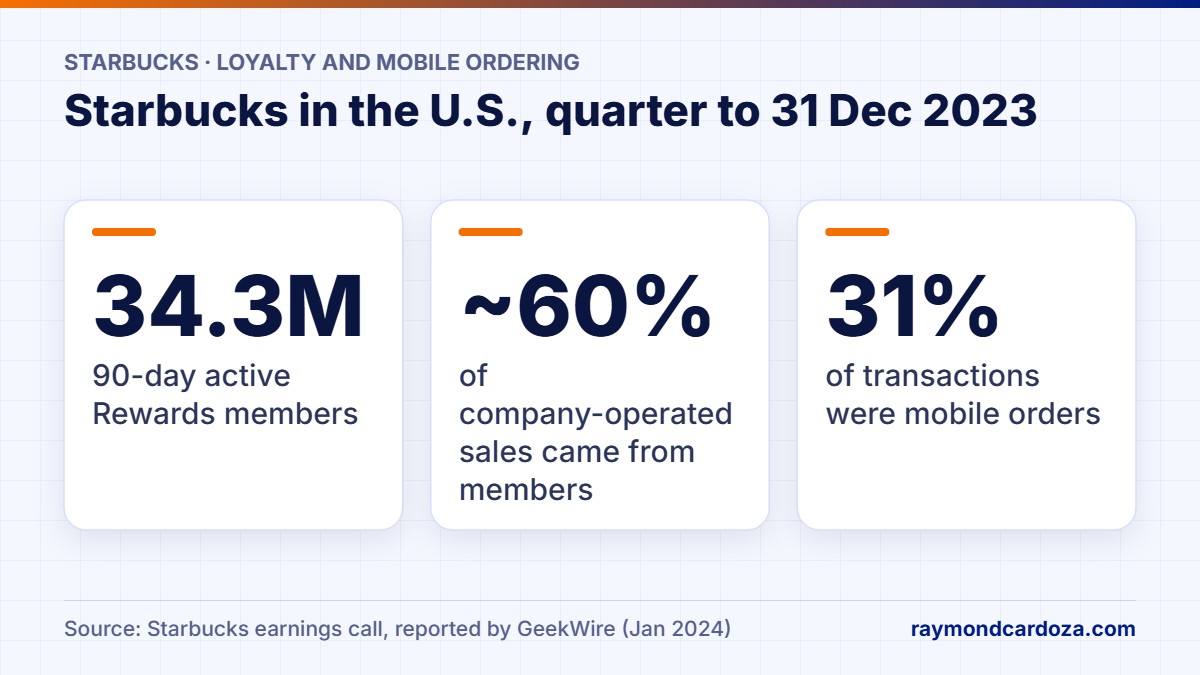
In short: By the end of 2023, Starbucks had 34.3 million active Rewards members in the U.S., generating nearly 60% of sales at company-operated U.S. stores, and mobile orders made up 31% of transactions. The success created a new problem: orders arriving faster than baristas could make them. In January 2025 CEO Brian Niccol said mobile orders “come flooding in” and announced an order-sequencing algorithm, and in August 2025 Starbucks said it would close its pickup-only store format.
This case is unusual because the technology worked. Customers adopted the app and the loyalty program in large numbers. The difficulty came from the store operations behind them, which is a lesson for any business that adds a digital channel.
At a glance
- Company: Starbucks Corporation
- Industry: Food and beverage retail
- Country: United States (figures are for U.S. stores)
- Period: Mobile ordering introduced about a decade before 2024; figures from fiscal 2024 and 2025
- Technology: Starbucks app, Mobile Order & Pay, Starbucks Rewards loyalty program, in-store order sequencing
- Focus: Customer relationship, loyalty and order flow
The challenge
A coffee chain depends on two things: speed at the counter and customers who come back. Starbucks tied both to one digital channel, its app, which combines ordering, payment and the Starbucks Rewards loyalty program.
The situation before
GeekWire notes that Starbucks introduced mobile order-ahead about a decade before 2024. Mobile orders grew from 25% of transactions at U.S. company-operated stores two years earlier to 27% a year earlier, and then 31% in the quarter to 31 December 2023, according to figures shared on the company’s earnings call.
The solution
The Starbucks app combines ordering, payment and the Rewards loyalty program, in which members earn rewards on purchases. In the quarter to 31 December 2023 there were 34.3 million 90-day active Rewards members in the U.S., up from 30.4 million a year earlier, and they generated nearly 60% of sales at company-operated U.S. stores.
Implementation and the operational problem
Mobile orders were handled in the same queue as in-store and drive-through orders. In January 2025 Niccol said mobile orders “come flooding in faster than even our customer can get there”, leaving drinks waiting on counters while customers in the store waited too. Earlier, in November 2023, Bloomberg reported that Starbucks was letting baristas pause mobile orders during busy periods.
In response, Starbucks said it was:
- Piloting an order-sequencing algorithm that prioritises orders rather than serving them strictly first in, first out
- Targeting a four-minute wait for in-store and drive-through orders
- Updating the app with scheduled ordering and simpler customisation
- Closing its pickup-only store format; Niccol called those stores “overly transactional and lacking the warmth and human connection that defines our brand” (August 2025)
Documented results
- 34.3 million 90-day active U.S. Rewards members in Q1 fiscal 2024, generating nearly 60% of U.S. company-operated sales (GeekWire, from the earnings call)
- 33.8 million 90-day active U.S. Rewards members in Q4 fiscal 2024, up 4% year on year (Starbucks results release)
- Mobile orders at 31% of U.S. company-operated transactions in Q1 fiscal 2024
The member count fell between Q1 and Q4 of fiscal 2024 (34.3 to 33.8 million), though it was still up year on year. Public sources reviewed do not yet give a verified numerical result for the 2025 order-sequencing changes.
Why this matters
A loyalty program and an app can shift customer behaviour quickly. If the operation behind them is not redesigned at the same time, the digital channel can harm the experience it was meant to improve, both for app users and for walk-in customers.
For smaller businesses the same thing happens when online orders, WhatsApp orders or bookings grow faster than the team that fulfils them.
What businesses can learn
- Design the back end with the front end. Every new channel needs capacity, sequencing and staff roles behind it.
- Set honest wait times. Promised times should reflect real capacity.
- Give staff controls. Being able to pause or pace digital orders protects quality at peak times.
- Use loyalty data for operations, not only marketing. Order patterns show when and where capacity is needed.
- Keep checking the whole experience. Measure walk-in and digital customers together.
Raymond Cardoza Enterprises perspective
When we set up ordering, booking or CRM systems for a business, we plan the workflow behind the screen first: who receives each order, in what order work is done and what happens at peak times. That is the thinking behind our business automation work and our lead capture and follow-up case study.
Sources and verification
Every figure in this case study comes from the sources below. Primary sources are listed first.
- Starbucks Q4 and fiscal 2024 results release (30 Oct 2024)
- GeekWire (Jan 2024): Starbucks mobile orders surpass 30% of total transactions at U.S. stores
- CX Dive (Jan 2025): Starbucks CEO zeroes in on bringing order to mobile ordering
- GeekWire (Aug 2025): Starbucks pioneered mobile ordering. Now it is ditching pickup-only stores
Is your team keeping up with your digital orders?
We will map how orders and enquiries flow through your business today and show you where to add capacity, rules or automation.
Call +91 98804 69174 · info@raymondcardoza.com · Business Automation services
Case study type: External real-world case study - not a Raymond Cardoza Enterprises client project. Starbucks is not a client of Raymond Cardoza Enterprises, and RCE had no involvement in the project described. This analysis is based only on the public sources listed above, as available in October 2026.